
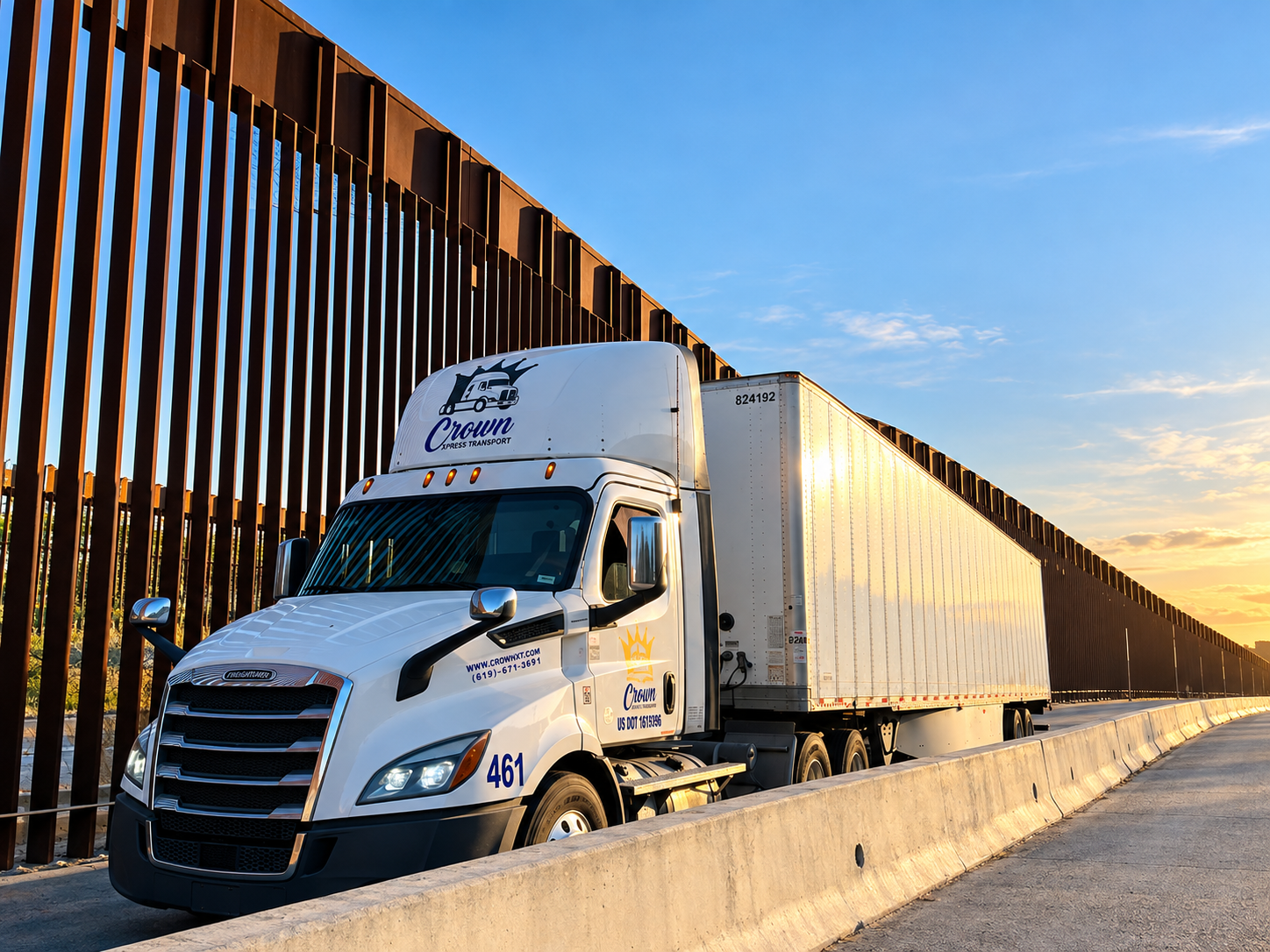
Cross-Border Trucking in 2026: Why Capacity Is About More Than Available Trucks
By Crown Xpress Transport | Octuber 6, 2026 | Read time: 5 minutes
Ask three shippers how much cross-border capacity is out there right now and you’ll get three answers, all measured in trucks. So many units, so many carriers, so many lanes running into Otay Mesa. It’s a tidy number. It’s also the wrong one — or at least only a sliver of the real one.
A tractor parked in a yard in Tijuana isn’t capacity. A truck with no driver cleared to cross isn’t capacity. A load that’s built, tarped and ready but sitting behind one missing document isn’t going anywhere, and it doesn’t care how many empty units are idling a mile up the road. Capacity at the border isn’t a count of equipment. It’s how often the whole chain lines up at the same time.
That distinction stays quiet most of the year. In 2026, with freight stacking up into Q4, it’s the whole game.
What “capacity” actually means at the border
Move one load across and you see how many things had to agree. You need the right unit for the freight — a 53′ dry van, a reefer holding temp, a flatbed with the straps that commodity requires, a chassis that’s actually where it’s supposed to be. You need a driver who’s not just licensed but authorized and comfortable crossing. You need documentation that’s complete and correct the first time: commercial invoice, the right classification, the broker lined up on both sides. You need all of it available inside the same window the border is open. And then you need the crossing itself to cooperate.
Every one of those is a valve. Any single one can choke the whole flow, and when it does, the other links stop mattering. That’s why a number built on truck counts tells you so little. It measures one valve and ignores the other five.
The driver piece is tighter than the truck piece
This is where it bites first. A domestic CDL driver and a cross-border driver are not interchangeable. Crossing adds authorization requirements, FAST enrollment to move through inspection faster, the paperwork fluency to not get turned around, and the patience to sit in a line that has nothing to do with how good you are behind the wheel. The pool of operators who do all of that well is smaller than the pool of drivers overall — and it doesn’t grow just because volume does.
So when nearshoring pushes more manufacturing freight toward the border, the driver bottleneck tightens first. You can buy another truck in a week. You can’t produce a seasoned cross-border operator in a week. FreightWaves has pointed at exactly this tension: nearshoring-driven demand running straight into a cross-border capacity base that isn’t expanding at the same pace. More freight, same narrow door.
Documentation and timing are capacity too
The least glamorous part of this strands the most loads. A shipment that clears cleanly is one whose paperwork was right before the truck ever left — classification correct, invoice matching, CTPAT handled where it applies, both brokers ready. Get one field wrong and the “available” truck is sitting at the bridge instead of delivering, already late for whatever it was supposed to grab next. One delay doesn’t cost you one load; it ripples through the rest of that unit’s week.
Timing is its own constraint. Border hours are finite. Inspection volume surges as everyone pushes product before year-end. Customs scrutiny has been climbing. All of it compresses the genuinely usable part of the day, so the same truck covers fewer productive miles than the map promises.
Why this is sharper in 2026
The backdrop is a market still sending more freight toward the Southern California gateways. C.H. Robinson’s freight reporting continues to put Otay Mesa among the top truck gateways on the U.S.–Mexico border, with cross-border volume climbing on the back of nearshoring. Put growing volume and a structurally narrow crossing together, aim them at the busiest quarter of the year, and you get the squeeze shippers are feeling now.
The companies feeling it least aren’t the ones with the most trucks. They’re the ones who stopped counting equipment and started planning the whole chain — driver, documents, timing, hand-off — before the load was ever booked.
What it looks like done right
This is the part that never shows up on a capacity dashboard. It’s a dispatcher who already knows which driver is cleared for which crossing and books accordingly. It’s a team that catches a classification gap on Tuesday instead of finding it at the bridge on Thursday. It’s a hand-off between the Mexican and U.S. sides that was coordinated in advance, not improvised at the line. None of that shows in a truck count. All of it is the difference between a load that crosses on time and one that doesn’t.
That’s how we think about capacity at Crown Xpress Transport — not how many tractors sit on a lot, but whether everything lines up so your freight moves when it’s supposed to. The trucks are the easy part. The coordination around them is the job.
If capacity has gotten unpredictable for your cross-border freight this quarter, that’s usually the chain talking, not the equipment — and the chain is something you can plan for.
sales@crownxt.com
+1 (619) 778-6170